


TL;DR
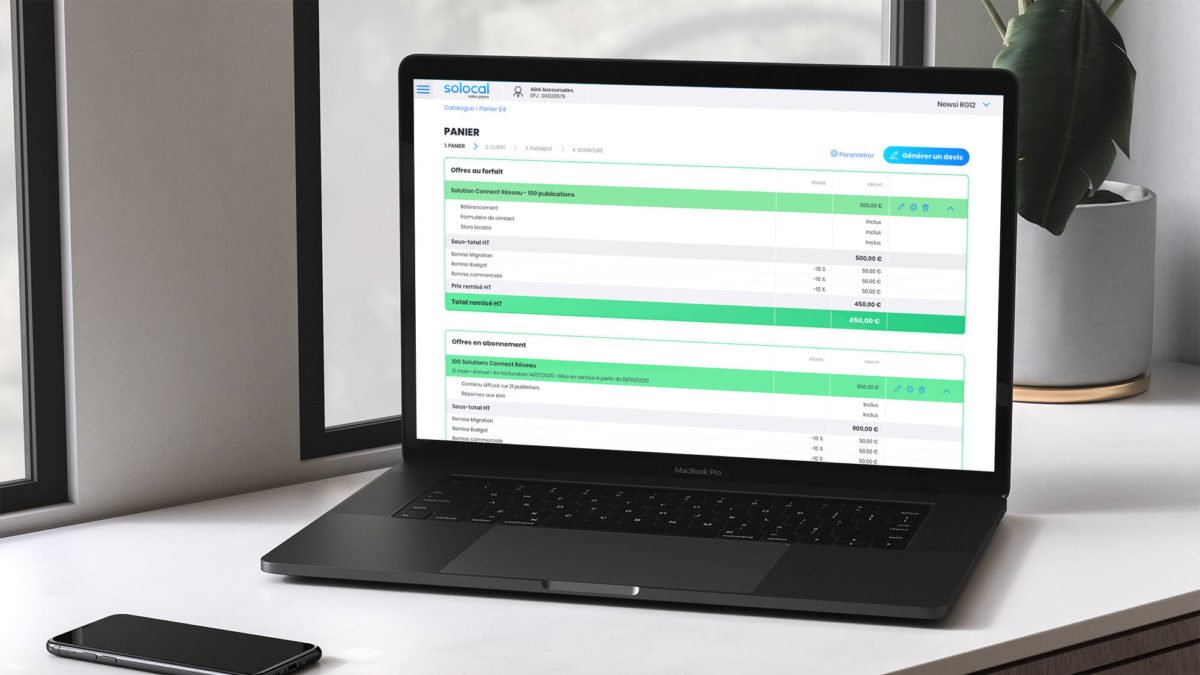
Embedded as Product Designer in Solocal’s Customer Success Department to build a proprietary sales tool from the ground up. Transformed limited stakeholder access into deep user insights, establishing an Agile design practice that empowered a remote product team to deliver a scalable, multi-product sales platform.
INFOS
- Client: Solocal
- Role: Product Designer (Part-time secondment to Customer Success)
- Target Users: Travelling and office-based sales teams
SKILLS & TOOLS
- Product Design
- UX/UI Design
- User Research
- Design Systems
- Figma
- Agile Methodology
The challenge: building blind
Sales teams needed a powerful new tool, but I had virtually no access to end-users as it was 2020-2021 and confinements were messing with the workplace.
Armed only with legacy tool audits and marketing manager briefs, I risked designing in a vacuum—creating beautiful screens that wouldn’t survive real-world sales pressure.
My approach
1. Discovery: breaking through barriers
- Audited existing tools to identify strengths, weaknesses, and hidden pain points
- Spent 2 days shadowing telemarketers: Turned restricted access into immersive field research, capturing real workflows and frustrations
- Created personas synthesizing user behaviors, needs, and contexts to anchor team decisions
- Collaborated with stakeholders to define crisp MVP scope balancing ambition with delivery reality
2. Design: from vision to system
- Co-designed seamless user journeys with Architect and Product Owner, ensuring technical feasibility from day one
- Iterated through wireframes and interactive prototypes, stress-testing the target vision against real scenarios
- Built dedicated Design System: Empowered 5 remote developers to implement user stories autonomously while maintaining design integrity
- Established UX principles as guardrails for consistency through roadmap changes, feature additions, and team transitions
3. Scale: engineering for the future
- Designed adaptable infrastructure: Created industrialized tool capable of hosting multiple product types without architectural redesign
- Worked within Agile Feature Team, delivering iteratively while maintaining strategic coherence
- Enabled international collaboration across Product Owner, Architect, and distributed development team
Outcomes
- Sales teams gained efficient, user-centered tool replacing legacy systems
- Design System enabled autonomous development, accelerating delivery velocity
- Scalable architecture positioned platform for future product expansion
- UX principles maintained design consistency despite evolving requirements
Key learnings
- Access constraints force creative research: Two shadowing days yielded richer insights than months of secondhand briefings could provide
- Design Systems are empowerment tools: Well-crafted systems transform developers into design decision-makers, not just implementers
- Principles outlive designers: Codifying UX principles created institutional memory that guided the product beyond individual tenure
Beyond delivery: The real success was building design infrastructure robust enough that the product could evolve confidently after I transitioned out.